
Opening Questions
- When we say a battery has internal resistance, what does that mean?
- How does current change across resisters in parallel?
Objectives
I will be able to:
- relate current and voltage for a resistor.
- identify on a circuit diagram whether resistors are in series or in parallel.
- calculate the equivalent resistance of a network of resistors that can be broken down into series and parallel combinations.
- calculate the voltage, current and power dissipation for any resistor in such a network of resistors connected to a single power supply.
- calculate the terminal voltage of a battery of specified emf and internal resistance from which a known current is flowing.
Words/Formulae For the Day
- Current: The amount of charge flowing through a circuit.
- Voltage/EMF: Electric potential—the ability to make charges go.
- Internal resistance: Resistance within a battery itself.
Work O' The Day
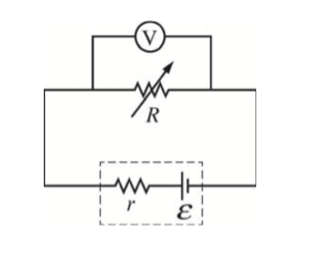
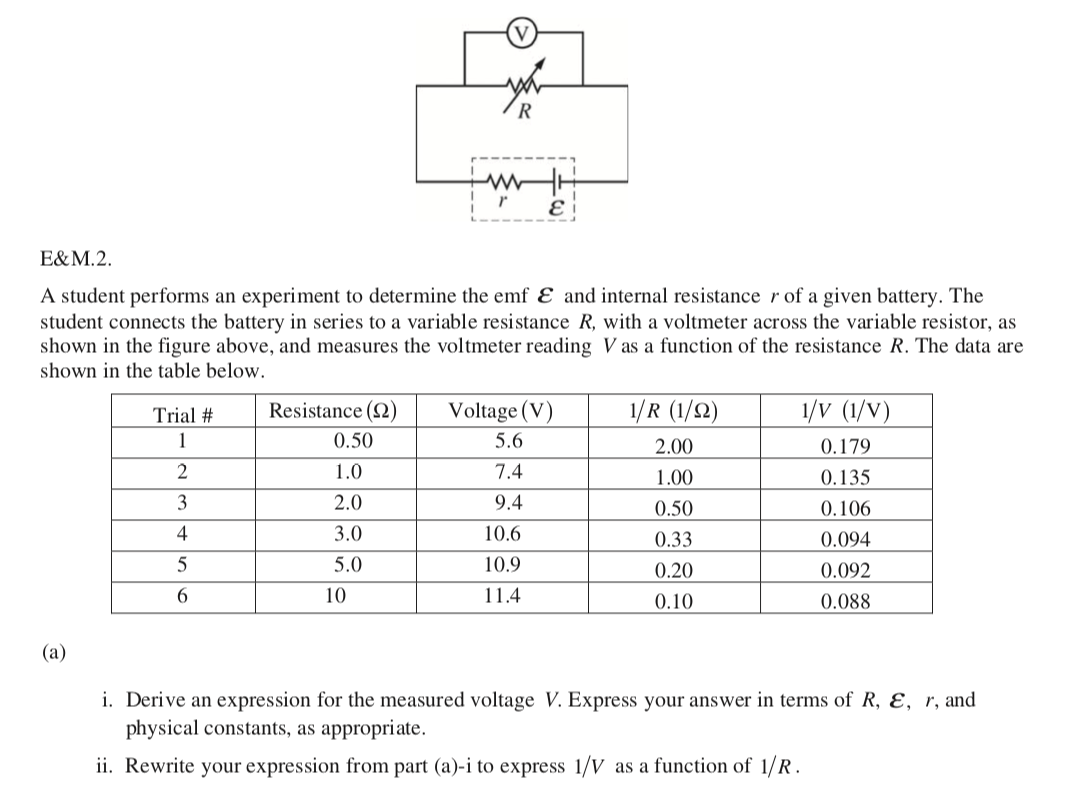
Alright, so we've got this little cirucit. There's some gunk in the problem about internal resistance, but we don't really care about it for now—as far as this part of the problem is concerned, a battery with an internal resistance and an ideal battery next to a resistor (like it's drawn in the circuit diagram) are the exact same thing.
With that out of the way, let's give our first question a read.
Derive an expression for the measured voltage . Express your answer in terms of , , , and physical constants, as appropriate.
The College Board Gods have spoken, and we shall obey unquestioningly. Let's start by calculating the total resistance of the circuit. We've got two resistors in parallel, so we just add them up and get our equivalent resistance:
We'll also need Ohm's law:
Let's plug in in for and in for .
Because our resisistors are in parallel, is the same everywhere in the circuit. So, determining the resistance () of our main resistor should be as simple as a second visit to our good friend Mr. Ohm.
Let's plug in our equation in for :
Note that while the R's look like they might cancel out, they don't (because one is the resistance of both resistors, and one is just that of our main one).
Finally, let's plug back in so that it's just in terms of their variables:
Alright, that's the first part done. Are the gods pleased?
Rewrite your expression from part (a)-i to express as a function of .
Not yet, it seems. This demand seems simple enough, just some algebraic manipulation. They seem to want inverses, so taking the reciprocal of both sides seems like a good start.
That looks about right. Let's simplify a bit by splitting up the fraction:
Now, we actually can cancel out some R's, so we do:
Finally, because they asked us to give it in terms of , so let's seperate that out so that the College Board Gods (or their lowly graders) have no excuse to mark us down.
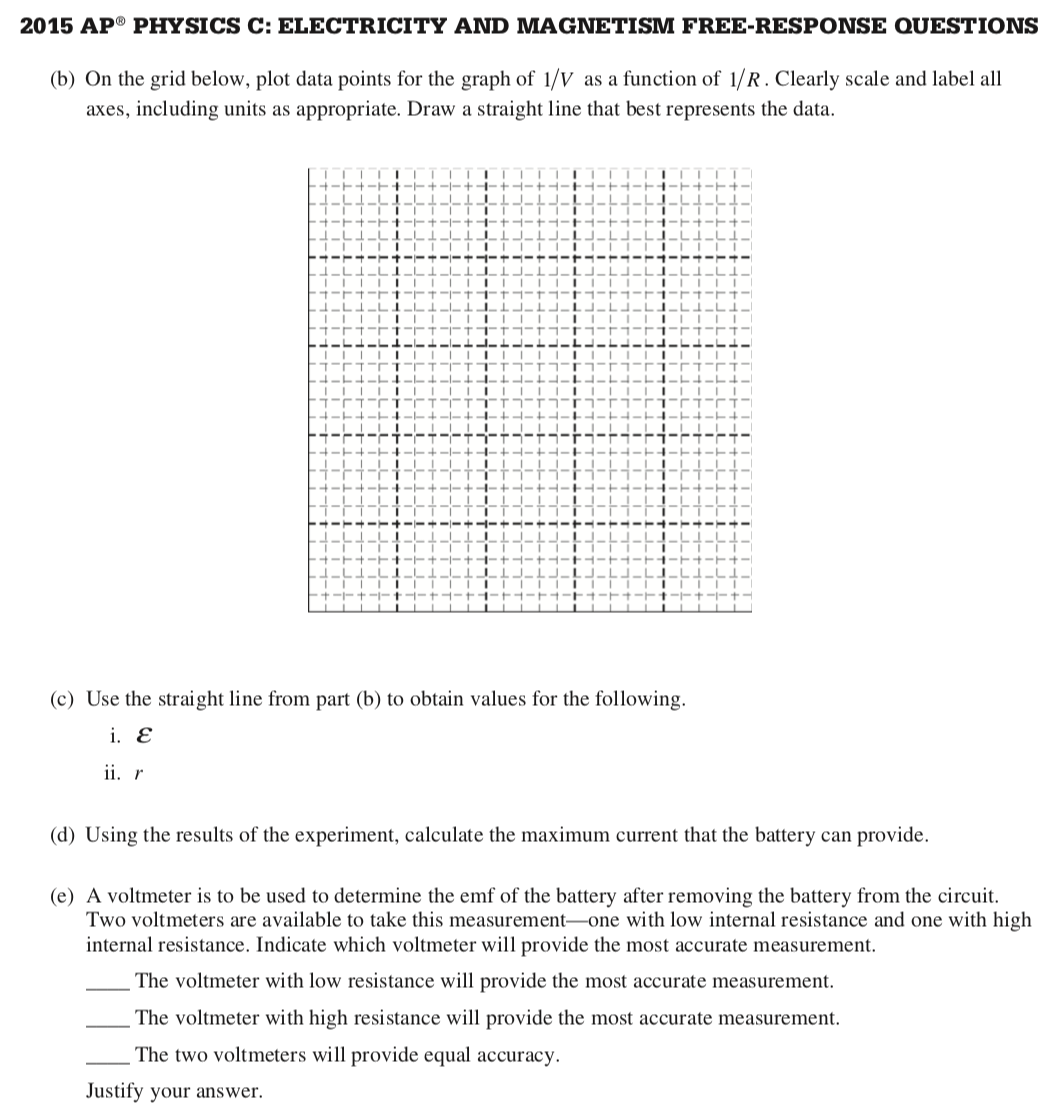
On the grid below, plot data points for the graph of as a function of . Clearly scale and label all axes, including units as appropriate. Draw a straight line that best represents the data.
Graphing? The gods must be especially angry today. Of course, we obey unquestioningly, graphing the points from the table and drawing a trendline.
(Note: For technical reasons, the graph above isn't labelled. On the real text, it would need labels for full points.)
Use the straight line from part (b) to obtain values for the following: , .
When all you've got's a TI-84, everything looks like a regression problem. So let's do just that. We end up with this equation:
Hey, that looks familiar! Remember this from earlier?
If we match up the variables, we can figure some things out:
Let's solve for :
And plug that in to find .
Using the results of the experiment, calculate the maximum current that the battery can provide.
Unsure if the College Board Gods will ever be satisfied, we trudge on through the darkness, starting with another look at Ohm's law.
Or, in this case,
We were asked to calculate the "maximum current the battery can provide." We know that in this case the voltage we're talking about is , so let's plug that in:
OK, so maybe if we can maximize , the College Board Gods will have mercy. is constant, so it looks like mimimizing is our best bet. They're asking about the batery itself, so we don't care about the other resistor in the circuit. However, we still have the internal resistance in the battery itself, , and we can't get any lower than that. Therefore,
A voltmeter is to be used to determine the emf of the battery after removing the battery from the circuit. Two voltmeters are available to take this measurement—one with low internal resistance and one with high internal resistance. Indicate which voltmeter will provide the most accurate measurement.
The high one. There, we're done. We've pleased the—
Justify your answer.
Darn. So this is something we haven't learned yet, but luckily it's pretty simple. A voltmeter contains a resistor with its own resistance. If the voltmeter's resistance is low, a lot of current will pass through it ( and all that), which means that the voltmeter itself will have a fairly big impact on the ciruit, which could result in an inaccurate mesurement. Therefore, voltmeters with a high internal resistance will be more accurate.
OK, now it seems that the College Board Gods are satisfied.
Reference

